what happens if you try to cut the cone through the origin
Introduction to Conic Sections
Conic sections are mathematically defined as the curves formed by the locus of a signal that moves a constitute such that its altitude from a fixed betoken is ever in a constant ratio to its perpendicular distance from the fixed line.
These three types of curves sections are Ellipse, Parabola, and Hyperbola. The curves, Ellipse, Parabola, and Hyperbola are also obtained practically by cutting the curved surface of a cone in unlike ways.
The profiles of the cut-flat surface from these curves are hence called conic sections. The figure shows the different possible ways of cut a cone.
Conic Sections

When a cone is cut by a plane perpendicular to the axis of the cone, the conic section volition exist a circle in Figure-A the plane-1 cuts the cone with its surface perpendicular to the axis of the cone and then as to produce a circle as shown in Effigy-B.
When a cone is cutting by a plane making an angle with the axis, greater than the generators of the cone make with the axis and so equally to cut both the stop generators of the cone, the conic section volition be an Ellipse. In Figure-A the plane-two cuts the centrality of the cone then as to produce an ellipse as shown in Figure-C.
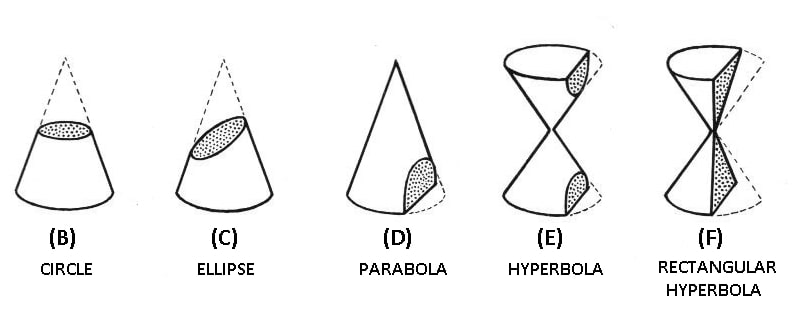
When a cone is cutting by a airplane parallel to one of the end generators of the cone, the conic department will be a parabola in Effigy-A the aeroplane-three is parallel to the correct end generator of the cone so equally to produce a parabola as shown in Figure-D.
When a cone is cut by a aeroplane making an angle with the centrality smaller than generators brand with the axis, the conic department will be a Hyperbola. In Figure-A the airplane-4 cuts the axis of the cone so as to produce a hyperbola as shown in Effigy-E.
When a cone is cut by a aeroplane parallel to the axis of the cone the conic sections volition be a Rectangular Hyperbola in Figur-A the plane-5 is parallel to the axis of the cone so as to produce a rectangular hyperbola as shown in Figure-F.
Read Also: Surface End & Surface Roughness with Indication & Symbols – Engg Drawing
Conic Sections Terminology:
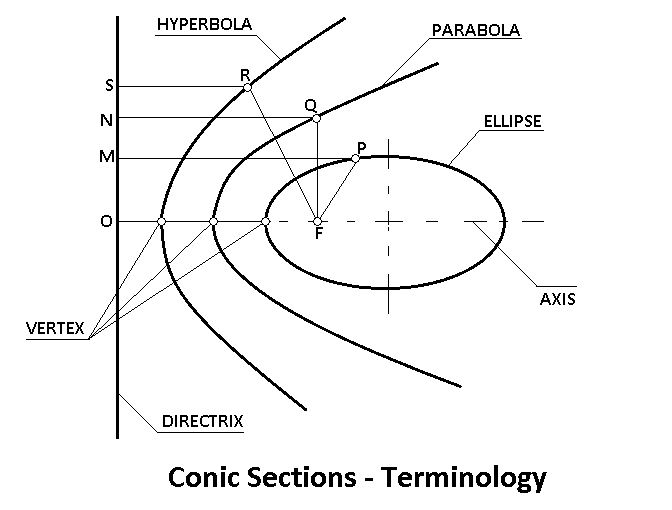
The stock-still point is called Focus, the fixed line is chosen Directrix, and the ratio of the distance of the tracing point from the focus to its perpendicular altitude from the directrix is called eccentricity.
A point at which the curves cut an axis is known as the vertex.
Definitions:
- Ellipse is the locus of a point P which moves such that the ratio of its distance from the fixed signal F to its altitude from a fixed line is a constant and is ever less than i.
- Parabola is the locus of a point Q which moves such that the ratio of its distance from the fixed point F to its distance from the fixed-line is a abiding and is always equal to 1.
- Hyperbola is the locus of a point R which moves such that the ratio of its altitude from the fixed signal F to its distance from the fixed-line is a constant and is always greater than 1.
Ellipse
Applications: Ellipse is the near unremarkably used mathematical curve often employed in architectural and technology constructions, Effigy shows the few applications of the ellipse in engineering constructions.
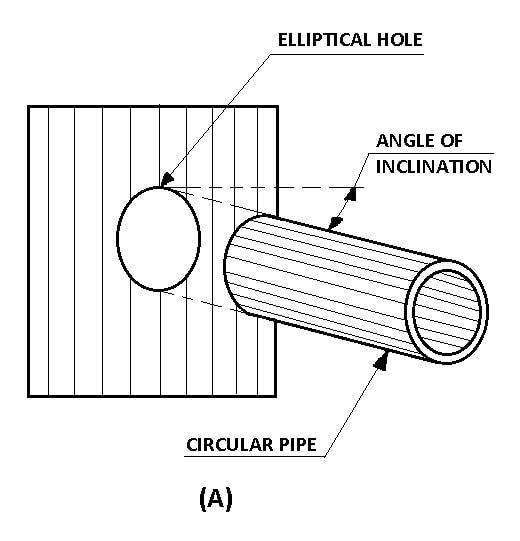
Whenever a cylindrical piping is to be connected to a plane surface inclined to it, the contour of the end of the pipe which is connected to the aeroplane surface and the shape of the hole in the plane surface will take to be ellipse as shown in Figure-A.
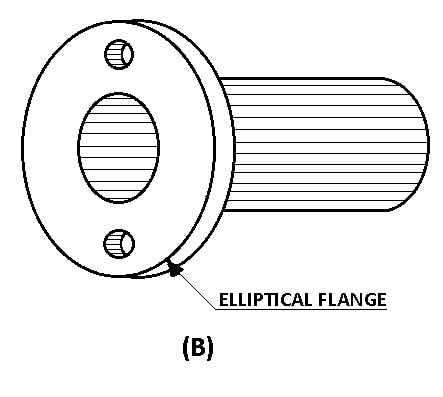
The flanges of pipes are generally designed to be elliptical equally shown in Figure-B.
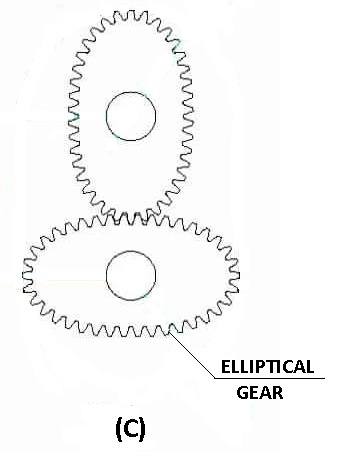
The elliptical gears shown in Effigy-C are used to obtain varying speed rate in each revolution in packaging machines, fabric equipment, flying shears, printing machines, etc.
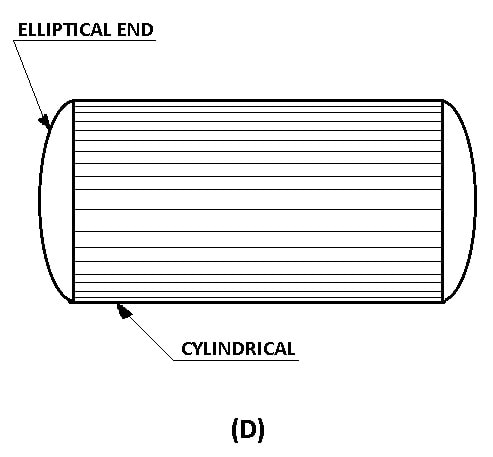
The ends of cylindrical tanks are made generally elliptical equally shown in Figure-D.
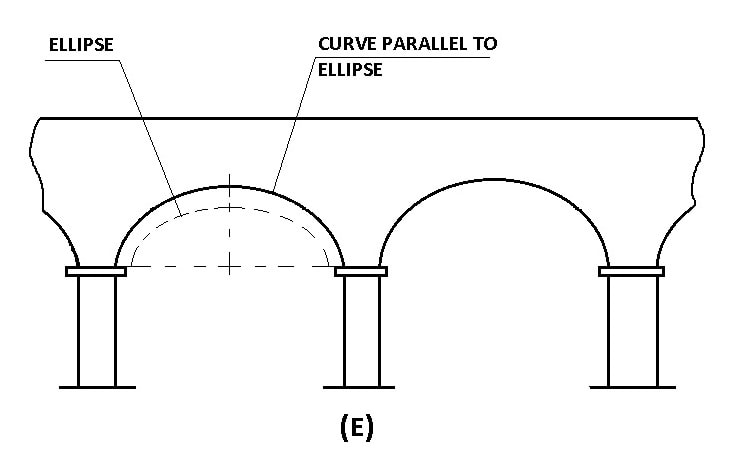
The arches of bridges will exist mostly of curves parallel to an ellipse equally this gives greater vertical clearance about the abutments than the true ellipse every bit shown in Effigy-E.
Definition and Terminology:
Ellipse is besides divers as the locus of a point which moves such that the sum of its distances from the 2 fixed points is a constant which is equal to the length of the major centrality.
F1 and F2 are two fixed points called foci. The line AB which passes through the foci with its end A and B lying in the curve is called a major axis. The line CD which bisects the axis having its ends C and flying on the bend is called small axis.
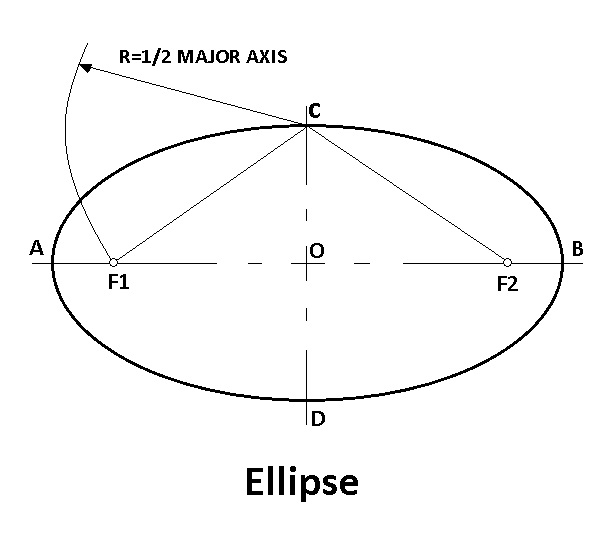
By using the higher up definition, when the major and minor axis is given, location and the altitude between the foci can exist establish.
To observe foci when Major nad Minor axis are given in Figure.
Since C is a point in the ellipse, the sum of its distances from F1 & F2 is equal to the major axis.
i.e., CF1+CF2=AB
Since C is a point on the pocket-size axis,
CF1=CF2
∴CF1=CF2=(1/ii) AB
When the major and small axis are given the location of the foci are plant equally follows. Draw the major & minor centrality. With C or D as center and radius (1/ii), AB cut AB at F1 & F2.
Read also: What is Isometric Projection? [Isometric View, Cartoon and Representation]
Parabola
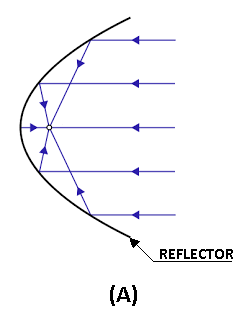
Applications: Parabola is widely used in engineering practice. Reflectors for parallel beams such as searchlights, headlamps of motor vehicles, etc, are in shape of a parabola. The lite rays emanating from the incandescent filament fixed at the focus of a parabolic reflector are reflected from each bespeak of the reflector parallel to each other as shown in the Figure-A.
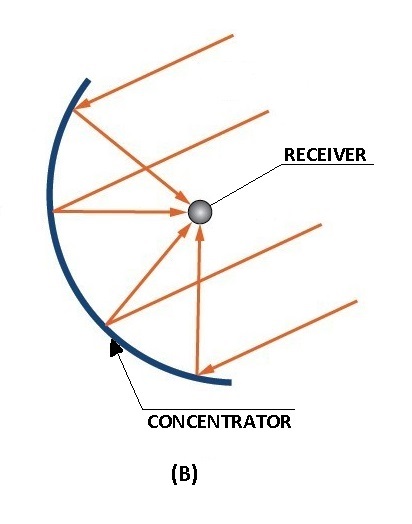
Similarly, all parallel rays bandage onto a parabolic receiver are concentrated at the focus every bit shown in Figure-B. This belongings of parabolic receivers is used in solar concentrators.
The parabolic shape is also used in machine tool building. The cantilever type of arms and wall brackets which are subjected to heavy bending loads are oftentimes designed to the shape of a parabola as shown in the Figure-C.
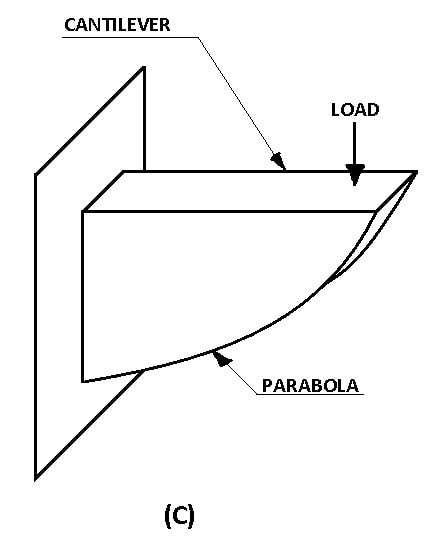
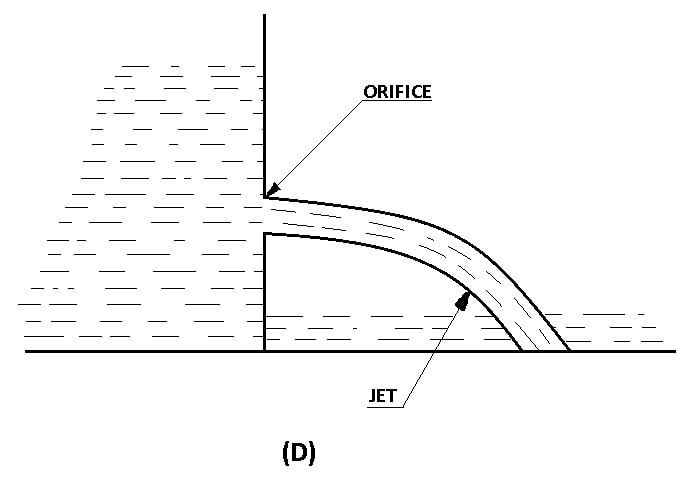
Such back up of compatible forcefulness offers the same resistance to bending. Parabolas are constitute in mechanics. The trajectory of a thrown object or missile is parabolic. The path of a jet of water issuing from a vertical orifice is parabolic as shown in Figure-D.
Hyperbola
Terminology:
Hyperbola is also defined as the bend generated by a point moving so that the deviation between its distance from the ii fixed points. F1 & F2 called foci is a constant, which is equal to the distance between A & B, the vertices of the hyperbola.
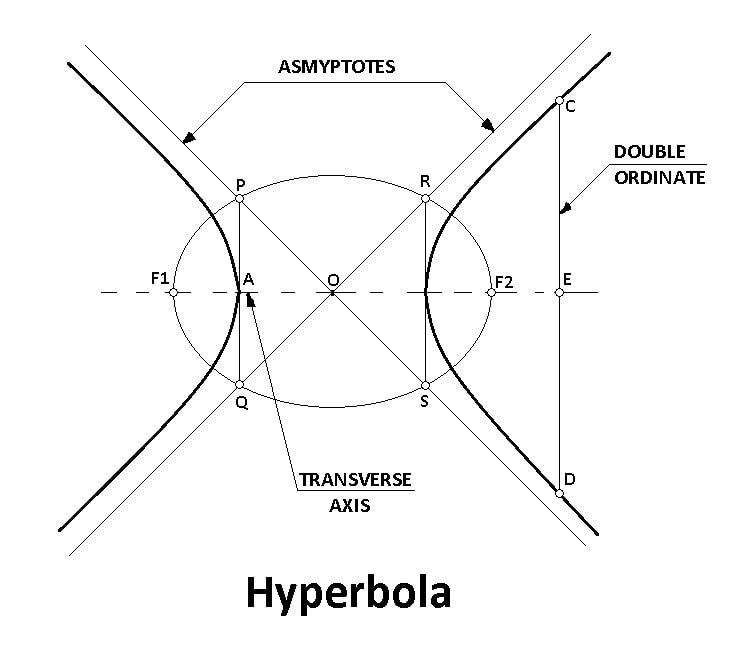
The distance between the two intersecting lines, called asymptotes PS & RO passing through the centre O, when produced arroyo nearer and nearer to the curves and will exist tangential to the curves at infinity. When the asymptotes are at correct angles, the bend is called rectangular or equilateral hyperbola.
Asymptotes are obtained as follows. With O as eye and radius, OF1 draw a circle. At A & B erect verticals to cut the circle at P, O, R & Due south. Connect PS & RO and produce them on either side.
That'south it, cheers for reading. If y'all accept any questions about the "conic sections" enquire in the comments I'll answer to y'all. If you like this commodity please share information technology with your friends. Subscribe to our newsletter. It's Gratis.
Download PDF of this article:
Read Next:
- Dimensions and Types of Dimensioning Systems
- 10 Unlike Types of Lines Used In Engineering Drawing
Source: https://www.theengineerspost.com/conic-sections/
0 Response to "what happens if you try to cut the cone through the origin"
Post a Comment